.jpg)
Temporary Workplace Rules: Can You Claim Tax Relief on Your Travel?
One of the most common questions about employment expense claims is whether a workplace is classed as permanent or temporary.
This distinction is important because it can determine whether travel to that location is ordinary commuting or qualifying business travel on which tax relief may be available.
Many UK employees travel to changing sites, customer properties, temporary offices and other work locations without realising that some of their travel costs could qualify for tax relief.
This guide explains how temporary workplace rules generally work, which journeys may qualify, how the 24-month rule applies and how Go Tax Refunds can help review your circumstances.
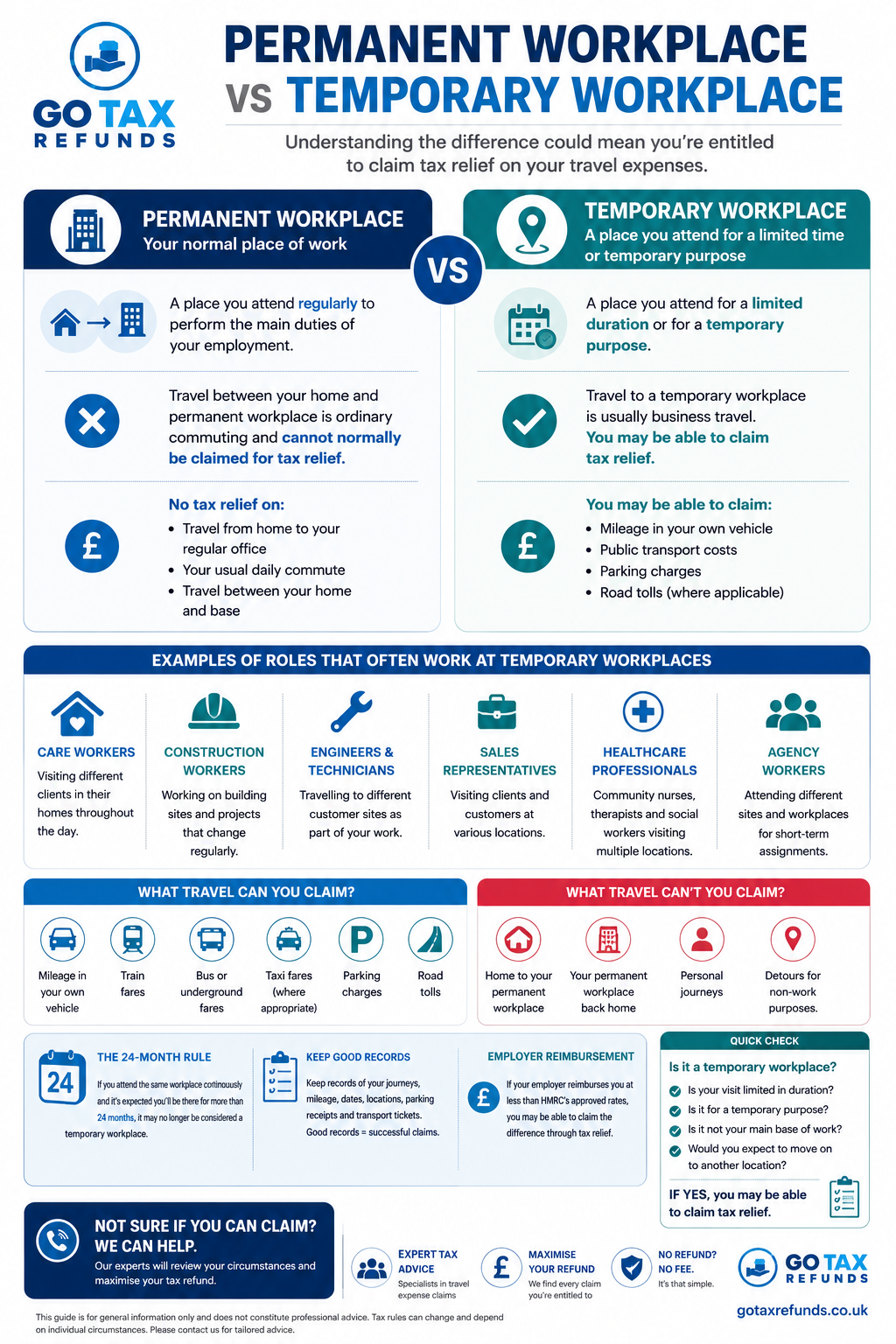
What Counts as a Temporary Workplace?
A temporary workplace is generally a location that an employee attends to perform a task of limited duration or for another temporary purpose.
Examples could include:
- A construction site attended for a particular project
- A customer or service user's home
- A client's premises attended for a temporary assignment
- A temporary office used during a short-term placement
- A property attended by an engineer, surveyor or technician
- A workplace attended while temporarily covering another employee
A workplace is not automatically temporary simply because you do not attend it every day or because your employment contract describes it as temporary.
HMRC considers the purpose, duration and pattern of your attendance, as well as whether the location has effectively become part of your normal working arrangement.
Employment status and workplace rules depend on the actual working arrangement. Each workplace and journey should be reviewed on its own facts.
What Counts as a Permanent Workplace?
A permanent workplace is generally a location that an employee attends regularly while performing the duties of their employment and which is not attended solely for a limited duration or temporary purpose.
For many office-based employees, their permanent workplace is the office, branch or building they normally attend.
Other examples may include:
- A warehouse attended as part of your normal working routine
- A hospital where you regularly perform your main duties
- A construction site expected to become a long-term workplace
- A fixed depot from which your normal working day begins
- A client site that has effectively become your regular workplace
Travel between your home and a permanent workplace is normally treated as ordinary commuting.
Ordinary commuting costs generally do not qualify for employment expense tax relief.
Why Does the Difference Matter?
The difference matters because travel to a temporary workplace may be treated as qualifying business travel, while travel between home and a permanent workplace is normally ordinary commuting.
Depending on your circumstances, eligible travel costs could include:
- Business mileage in your own vehicle
- Train fares
- Bus and coach fares
- London Underground fares
- Reasonable taxi fares where appropriate
- Qualifying parking charges
- Road tolls
You can read more about mileage claims in our Mileage Tax Relief Explained guide .
You can also use our free mileage calculator to estimate the possible value of qualifying business mileage.
Not every journey made because of your job automatically qualifies. The journey must satisfy the relevant employment travel rules and must not simply be ordinary commuting.
Can You Claim Travel From Home to a Temporary Workplace?
In many circumstances, an employee may be able to claim tax relief on the cost of travelling from home to a genuine temporary workplace.
For example, a construction worker who normally attends changing project sites may be able to claim qualifying mileage to those sites, provided the locations satisfy the temporary workplace rules.
Similarly, a healthcare worker sent to a temporary clinic or an engineer assigned to a short-term customer project may have qualifying travel.
However, a location will not qualify merely because it is different from your employer's main office.
HMRC may consider factors such as:
- Why you attend the location
- How often you attend it
- How long you expect to attend it
- How much of your working time is spent there
- Whether your journey changes significantly between sites
- Whether the location has become part of your normal work pattern
Who Commonly Works at Temporary Workplaces?
Temporary workplace rules commonly affect employees who work at changing locations, project sites, customer premises and service-user properties.
Domiciliary Care Workers
Domiciliary care workers may visit several service users in their homes during the same working day.
Travel between service users will commonly be business travel. Travel from home to the first service user and from the final service user back home requires a closer review of the employee's working pattern and whether the locations are temporary workplaces.
Construction Workers
Construction employees often work on projects that begin and end, requiring them to move between building sites.
A construction site may qualify as a temporary workplace where the worker attends it for a project of limited duration, provided the attendance does not fall within the 24-month rule or another restriction.
Self-employed subcontractors working under CIS are subject to different business expense considerations. More information is available on our CIS Tax Refund service page .
Engineers and Utility Workers
Telecoms engineers, gas engineers, maintenance technicians and utility workers commonly attend different customer sites and properties.
Travel between changing customer locations may qualify as business travel, depending on the worker's employment arrangement.
Sales Representatives
Sales representatives may spend a significant part of their working time travelling to customer premises, meetings and events.
Travel to customer locations may qualify where it is undertaken in the performance of the employee's duties and is not ordinary commuting.
Healthcare Professionals
Community nurses, occupational therapists, healthcare assistants and social workers may travel between patient homes, hospitals, clinics and care facilities.
The tax treatment will depend on whether each location is temporary, permanent or part of an area-based working arrangement.
Agency Workers
Agency workers may attend different client sites for short-term assignments.
However, being employed through an agency does not automatically make every assignment a temporary workplace. The location, expected duration and overall working arrangement must still be considered.
Members of the Armed Forces
Members of the Armed Forces may be required to attend different bases, postings and temporary duty locations.
Whether travel qualifies depends on the nature of the posting and the applicable employment travel rules.
What Travel Costs May Qualify?
Where a journey satisfies the temporary workplace or other qualifying business travel rules, you may be able to claim tax relief on eligible costs that you paid personally and were not fully reimbursed for.
Potential costs can include:
- Mileage in your own car or van
- Qualifying motorcycle or bicycle mileage
- Train fares
- Bus and coach fares
- London Underground fares
- Taxi fares where their use was necessary and reasonable
- Parking charges connected with qualifying business travel
- Road tolls connected with qualifying business travel
Tax relief does not normally mean that HMRC refunds the entire cost of the journey.
Relief is generally based on the qualifying expense and the rate of tax you paid, subject to the applicable rules and claim method.
Your actual entitlement depends on your tax position, the amount paid by your employer and the evidence available.
What Travel Costs Normally Do Not Qualify?
You cannot normally claim tax relief for personal travel or ordinary commuting.
Non-qualifying journeys commonly include:
- Travel from home to your permanent workplace
- Travel from your permanent workplace back home
- Private or personal journeys
- Personal detours made during a business journey
- Travel costs already reimbursed in full by your employer
- Journeys without a genuine employment-related purpose
You should not include the private part of a mixed business and personal journey.
What Is HMRC's 24-Month Rule?
The 24-month rule can prevent a workplace from being treated as temporary where an employee attends it as part of a period of continuous work lasting, or expected to last, more than 24 months.
For this purpose, HMRC generally treats work as being performed to a significant extent at a workplace where the employee spends at least 40% of their working time there.
A workplace may therefore become permanent where:
- You spend at least 40% of your working time there
- The period of attendance lasts or is expected to last more than 24 months
- The location would otherwise have been capable of being temporary
The rule is based on reasonable expectation, not simply the date on which 24 months is reached. If you learn after six months that your assignment will continue for three years, the workplace may become permanent from the point that expectation changes.
An example of the 24-month rule
Imagine an employee begins working full-time at a client site and initially expects the assignment to last 18 months.
The client site may initially qualify as a temporary workplace.
After 10 months, the employee is told that the assignment will continue for another two years.
At that point, the total expected period exceeds 24 months. The workplace may therefore be treated as permanent from the date the expectation changed, rather than from the end of month 24.
Moving between nearby sites may not restart the clock
A change of site will not necessarily create a new temporary workplace where the change has no substantial effect on the employee's journey to work.
For example, moving between different buildings in the same small area while continuing substantially the same commute may be treated as attendance at the same workplace for the 24-month rule.
What if You Work at Multiple Locations?
Having multiple workplaces does not automatically mean that every workplace is temporary.
An employee can have more than one permanent workplace, more than one temporary workplace, or a combination of both.
Examples of multi-location working include:
- A care worker visiting several service users each day
- A construction worker moving between different project sites
- An engineer visiting multiple customer premises
- A surveyor inspecting different properties
- A facilities manager responsible for several buildings
- A healthcare professional working across different clinics
The status of each location should be considered based on the reason for attendance, frequency, duration and overall working arrangement.
Regular attendance at several locations can mean that more than one location is a permanent workplace. The fact that you travel between sites does not by itself make each site temporary.
What if Your Employer Pays Mileage?
Receiving mileage payments from your employer does not always prevent you from claiming additional tax relief.
Where your employer pays less than HMRC's approved mileage amount for qualifying business travel, you may be able to claim Mileage Allowance Relief on the difference.
For example:
- You use your own vehicle for qualifying business journeys
- Your employer reimburses only part of the approved amount
- You retain appropriate mileage and reimbursement records
You may then be able to claim tax relief on the qualifying shortfall, rather than claiming the full mileage amount again.
If your employer has reimbursed the full approved amount, there will normally be no additional mileage shortfall on which to claim relief.
Our mileage tax relief guide explains how employer payments affect a potential claim.
What Records Should You Keep?
Good records are essential when making a tax relief claim and supporting the information submitted to HMRC.
Where possible, keep records of:
- The date of each journey
- The starting address
- The destination address
- The business purpose of the journey
- The number of business miles travelled
- Parking receipts
- Public transport tickets and receipts
- Road toll receipts
- Employer mileage statements
- The mileage rate paid by your employer
- Your work rota or assignment details
- Contracts, posting letters or project documents
Records relating to the duration and purpose of an assignment can be especially important where the temporary workplace or 24-month rules need to be considered.
Digital mileage logs, calendars and work schedules can also help establish a consistent record of your travel.
Common Temporary Workplace Claim Mistakes
Temporary workplace rules are frequently misunderstood by employees and employers.
Common mistakes include:
- Assuming every workplace away from the main office is temporary
- Assuming every short-term employment contract creates a temporary workplace
- Claiming ordinary commuting to a permanent workplace
- Failing to consider the 40% element of the 24-month rule
- Waiting until month 24 before reviewing a changed assignment
- Assuming that moving to a nearby site automatically restarts the 24-month period
- Claiming the full mileage amount after receiving employer reimbursement
- Including personal journeys or private detours
- Failing to keep mileage and journey records
- Claiming the cost rather than the tax relief due on the qualifying amount
Another common error is assuming that a refund is guaranteed. A valid expense claim may reduce your tax liability or produce a refund, but the outcome depends on the tax you paid and your wider circumstances.
Can You Claim for Previous Tax Years?
Depending on the type of claim and the applicable time limit, you may be able to claim tax relief for qualifying employment expenses from earlier tax years.
This can be particularly relevant where you have travelled to temporary workplaces for several years but have never previously claimed.
You will still need to show that the journeys qualified and provide reasonable supporting information.
The sooner you review your position, the less likely you are to lose a potential entitlement because a claim deadline has passed.
How Do You Claim Temporary Workplace Travel Tax Relief?
The appropriate claim route can depend on the value of your expenses, whether you already complete Self Assessment and the tax years involved.
A claim may potentially be made through:
- HMRC's employment expense claim process
- A P87 employment expense claim
- A Self Assessment tax return where applicable
Employees can claim directly from HMRC without using a tax refund company.
However, professional support can be useful where there are multiple workplaces, changing assignments, employer reimbursements or questions about the 24-month rule.
Visit our PAYE Tax Refund service page to learn more about claiming tax relief on eligible employment expenses.
People who already complete a tax return can also review our Self Assessment Tax Return service .
Frequently Asked Questions
Can I claim travel to different construction sites?
You may be able to claim tax relief where the construction sites are genuine temporary workplaces and you personally paid qualifying travel costs that were not fully reimbursed.
Each site should be reviewed based on the expected duration of the project, your attendance pattern and the 24-month rule.
Can domiciliary care workers claim mileage?
Many domiciliary care workers can claim Mileage Allowance Relief where they use their own vehicle for qualifying business journeys and their employer pays less than the applicable approved amount or pays nothing.
Travel between service users will commonly be business travel. Home-to- work journeys require consideration of the employee's full working arrangement.
Can I claim travel from home to a temporary workplace?
In many cases, yes. Travel from home to a genuine temporary workplace can qualify, provided the location satisfies HMRC's rules and the journey is not ordinary commuting.
Can I claim if my employer already pays mileage?
You may be able to claim additional relief if your employer reimburses you at less than HMRC's approved amount for qualifying business mileage.
The claim would normally relate to the qualifying difference, not the full mileage amount.
Does every workplace attended for less than 24 months qualify?
No. The 24-month rule is only one part of the test. The location must first be attended for a limited duration or temporary purpose and must otherwise be capable of being a temporary workplace.
What happens if my assignment is unexpectedly extended?
The workplace may initially qualify as temporary. If your reasonable expectation later changes so that you expect to spend at least 40% of your working time there for more than 24 months, it may become permanent from the date the expectation changes.
Can I claim for journeys made several years ago?
You may be able to claim for previous tax years if the expenses qualified and you remain within the applicable claim deadline.
Check Whether You Are Missing Out on Travel Tax Relief
Temporary workplace rules can be difficult to apply, particularly when you attend multiple locations, work on changing projects or receive partial mileage payments from your employer.
Go Tax Refunds can help you:
- Review your workplace and travel arrangements
- Identify which locations may qualify as temporary workplaces
- Check how the 24-month rule affects your claim
- Review mileage payments made by your employer
- Calculate qualifying mileage and travel expenses
- Check whether previous tax years can still be claimed
- Prepare and submit the appropriate claim to HMRC
Whether you are a care worker, construction worker, engineer, healthcare professional, sales representative, agency worker or member of the Armed Forces, our team can review your individual circumstances.
Our goal is to help you identify every legitimate entitlement while ensuring that your claim is prepared correctly and supported by the available records.
Contact Go Tax RefundsThis guide provides general information and should not be treated as personal tax advice. Workplace status, qualifying travel, mileage relief and claim eligibility depend on individual circumstances and current HMRC rules. Employees can submit eligible expense claims directly to HMRC without using a tax refund company.
.jpg)
.jpg)
.jpg)